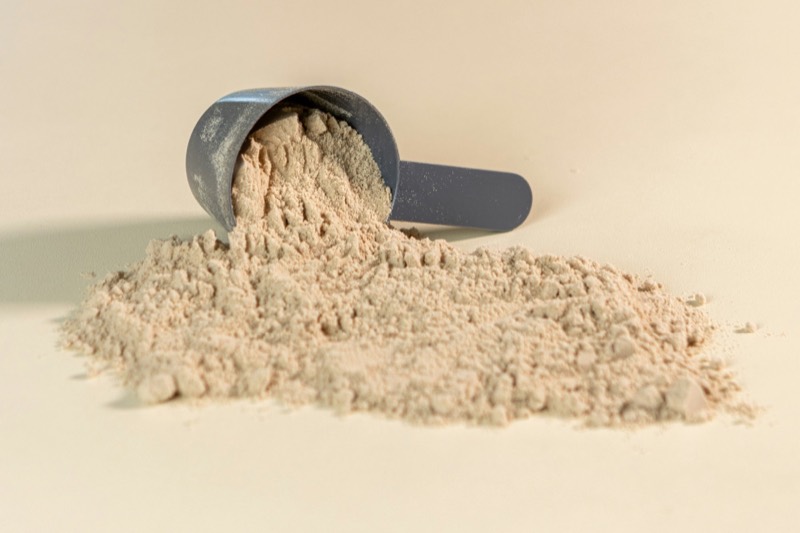
The dose used in studies
20–40 g per serving (about 0.25 g/kg), toward a daily total of 1.4–2.0 g/kg
In Morton 2018, total protein intakes above ~1.6 g/kg/day gave no further gains in fat-free mass. Whole food can cover needs; powder is a convenience (ISSN). Plant proteins: soy performed like milk protein, while other plant proteins gave slightly less muscle in Reid-McCann 2025.
- 20 g per serving
Maximally stimulated muscle protein synthesis after leg exercise in young men; 40 g mostly increased oxidation.[13]
- 40 g vs 20 g after whole-body training
40 g stimulated more muscle protein synthesis (0.059 vs 0.049 %/h).[14]
- 100 g vs 25 g
100 g gave a bigger and longer (>12 h) anabolic response, so large meals are not 'wasted'.[15]
- Daily total ~1.6 g/kg
Extra fat-free-mass gains level off at about 1.62 g/kg/day; one review treats 2.2 g/kg/day as the upper end of useful intake.[1][12]
- 2.3–3.1 g/kg/day while dieting
May be needed to best preserve lean mass during calorie restriction.[3]
Total daily protein matters far more than timing: once total intake was accounted for, eating protein right around workouts made no significant difference. Spreading intake into about 20 g every 3 hours beat smaller frequent or larger infrequent doses for muscle protein synthesis over 12 hours, and 30–40 g casein before sleep raises overnight synthesis.[3][20][21]
Effects appear over training programmes of at least 6 weeks; in untrained people supplemental protein likely has no impact during the first weeks of training (Pasiakos 2015).
Which form is best?— hover or tap
Typically 70–80% protein in sports products; fast-digesting and high in leucine.[3]
Typically 70–80% protein in sports products; fast-digesting and high in leucine.[3]
Over 90% protein, with less lactose and fat; same proteins as concentrate.[3]
One 12-week RCT (by the manufacturer) found muscle-thickness gains similar to whey.[19]
Plant protein overall gave slightly less muscle than animal protein (SMD −0.20); non-soy plant data rest on only 5 RCTs.[18]
Who benefits most
- People eating below about 1.6 g/kg/day of protein
- Older adults who lift (they need about 0.40 g/kg per meal vs 0.24 g/kg in young men)
- Lifters in a calorie deficit (higher needs, 2.3–3.1 g/kg/day)
- People already eating at least 1.6 g/kg/day from food
- Untrained people in their first weeks of training
- Older adults taking whey without resistance training
Taking it with other supplements
Adding carbohydrate after training did not increase muscle protein synthesis beyond adequate protein alone; carbohydrate mainly helps glycogen recovery.[3]
One 10-week trial in older men found extra lean mass and bench-press gains from creatine plus whey, but other studies found no added benefit.[23]
Is the rest of your stack worth it?
Tick what you take. Keep, drop or add, in about a minute.
More on Protein powder
- [1]Morton RW, et al. A systematic review, meta-analysis and meta-regression of the effect of protein supplementation on resistance training-induced gains in muscle mass and strength in healthy adults. Br J Sports Med. 2018;52(6):376-384. Meta-analysis PubMed · DOI
- [2]Nunes EA, et al. Systematic review and meta-analysis of protein intake to support muscle mass and function in healthy adults. J Cachexia Sarcopenia Muscle. 2022;13(2):795-810. Meta-analysis · industry ties PubMed · DOI
- [3]Jäger R, et al. International Society of Sports Nutrition Position Stand: protein and exercise. J Int Soc Sports Nutr. 2017;14:20. Position stand PubMed · DOI
- [4]Zhao S, et al. The effectiveness of protein supplements on athletic performance and post-exercise recovery - a Bayesian multilevel meta-analysis of randomized controlled trials. J Int Soc Sports Nutr. 2026;23(1):2605338. Meta-analysis PubMed · DOI
- [5]Liao CD, et al. Effects of protein supplementation combined with resistance exercise on body composition and physical function in older adults: a systematic review and meta-analysis. Am J Clin Nutr. 2017;106(4):1078-1091. Meta-analysis PubMed · DOI
- [6]Al-Rawhani AH, et al. Effectiveness of whey protein supplementation on muscle strength and physical performance of older adults: A systematic review and meta-analysis of randomized clinical trials. Clin Nutr. 2024;43(10):2412-2426. Meta-analysis PubMed · DOI
- [7]Moore DR, et al. Protein ingestion to stimulate myofibrillar protein synthesis requires greater relative protein intakes in healthy older versus younger men. J Gerontol A Biol Sci Med Sci. 2015;70(1):57-62. Review PubMed · DOI
- [8]Bauer J, et al. Evidence-based recommendations for optimal dietary protein intake in older people: a position paper from the PROT-AGE Study Group. J Am Med Dir Assoc. 2013;14(8):542-59. Position stand PubMed · DOI
- [9]Pearson AG, et al. The impact of dietary protein supplementation on recovery from resistance exercise-induced muscle damage: A systematic review with meta-analysis. Eur J Clin Nutr. 2023;77(8):767-783. Meta-analysis PubMed · DOI
- [10]Davies RW, et al. The Effect of Whey Protein Supplementation on the Temporal Recovery of Muscle Function Following Resistance Training: A Systematic Review and Meta-Analysis. Nutrients. 2018;10(2):221. Meta-analysis PubMed · DOI
- [11]Pasiakos SM, et al. Effects of protein supplements on muscle damage, soreness and recovery of muscle function and physical performance: a systematic review. Sports Med. 2014;44(5):655-670. Systematic review PubMed · DOI
- [12]Schoenfeld BJ, Aragon AA. How much protein can the body use in a single meal for muscle-building? Implications for daily protein distribution. J Int Soc Sports Nutr. 2018;15:10. Review PubMed · DOI
- [13]Moore DR, et al. Ingested protein dose response of muscle and albumin protein synthesis after resistance exercise in young men. Am J Clin Nutr. 2009;89(1):161-8. Randomized trial PubMed · DOI
- [14]Macnaughton LS, et al. The response of muscle protein synthesis following whole-body resistance exercise is greater following 40 g than 20 g of ingested whey protein. Physiol Rep. 2016;4(15):e12893. Randomized trial PubMed · DOI
- [15]Trommelen J, et al. The anabolic response to protein ingestion during recovery from exercise has no upper limit in magnitude and duration in vivo in humans. Cell Rep Med. 2023;4(12):101324. Randomized trial PubMed · DOI
- [16]Tang JE, et al. Ingestion of whey hydrolysate, casein, or soy protein isolate: effects on mixed muscle protein synthesis at rest and following resistance exercise in young men. J Appl Physiol (1985). 2009;107(3):987-92. Randomized trial PubMed · DOI
- [17]Messina M, et al. No Difference Between the Effects of Supplementing With Soy Protein Versus Animal Protein on Gains in Muscle Mass and Strength in Response to Resistance Exercise. Int J Sport Nutr Exerc Metab. 2018;28(6):674-685. Meta-analysis PubMed · DOI
- [18]Reid-McCann RJ, et al. Effect of Plant Versus Animal Protein on Muscle Mass, Strength, Physical Performance, and Sarcopenia: A Systematic Review and Meta-analysis of Randomized Controlled Trials. Nutr Rev. 2025;83(7):e1581-e1603. Meta-analysis PubMed · DOI
- [19]Babault N, et al. Pea proteins oral supplementation promotes muscle thickness gains during resistance training: a double-blind, randomized, Placebo-controlled clinical trial vs. Whey protein. J Int Soc Sports Nutr. 2015;12(1):3. Randomized trial · industry ties PubMed · DOI
- [20]Schoenfeld BJ, Aragon AA, Krieger JW. The effect of protein timing on muscle strength and hypertrophy: a meta-analysis. J Int Soc Sports Nutr. 2013;10(1):53. Meta-analysis PubMed · DOI
- [21]Areta JL, et al. Timing and distribution of protein ingestion during prolonged recovery from resistance exercise alters myofibrillar protein synthesis. J Physiol. 2013;591(9):2319-31. Randomized trial PubMed · DOI
- [22]Pasiakos SM, et al. The effects of protein supplements on muscle mass, strength, and aerobic and anaerobic power in healthy adults: a systematic review. Sports Med. 2015;45(1):111-131. Systematic review PubMed · DOI
- [23]Antonio J, et al. Part II. Common questions and misconceptions about creatine supplementation: what does the scientific evidence really show?. J Int Soc Sports Nutr. 2025;22(1):2441760. Review PubMed · DOI
- [24]Devries MC, et al. Changes in Kidney Function Do Not Differ between Healthy Adults Consuming Higher- Compared with Lower- or Normal-Protein Diets: A Systematic Review and Meta-Analysis. J Nutr. 2018;148(11):1760-1775. Meta-analysis PubMed · DOI
- [25]Shams-White MM, et al. Dietary protein and bone health: a systematic review and meta-analysis from the National Osteoporosis Foundation. Am J Clin Nutr. 2017;105(6):1528-1543. Meta-analysis PubMed · DOI
- [26]Maughan RJ, et al. IOC consensus statement: dietary supplements and the high-performance athlete. Br J Sports Med. 2018;52(7):439-455. Position stand PubMed · DOI
- [27]Berryman CE, et al. Protein intake trends and conformity with the Dietary Reference Intakes in the United States: analysis of the National Health and Nutrition Examination Survey, 2001-2014. Am J Clin Nutr. 2018;108(2):405-413. Review PubMed · DOI
Last reviewed 03 Oct 2026. Information, not medical advice.