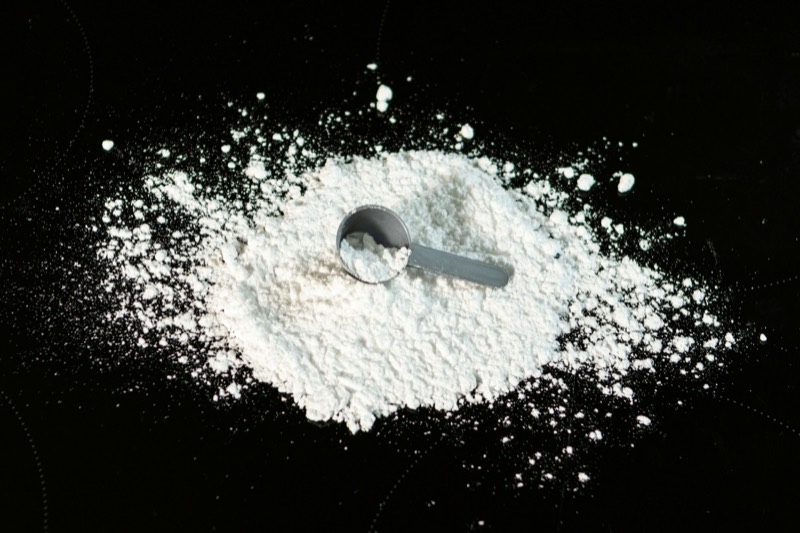
Works afterEffects appear after at least 2–4 weeks of daily use
Evidence20 papers read
Does it work?
The label shows how strong the evidence is, not how big the effect is. Tap a claim to see its papers.
The takeaway
In plain words
In a lab cycling test at 110% of max power, 4 weeks of beta-alanine increased total work by 13.0%. In real time trials the gain is smaller: the pooled effect was large for time-to-exhaustion tests (ES 0.50) but not significant for performance tests (ES 0.11). It does not raise one-rep max: an 8-week RCT found bench press +0.8 kg vs placebo, not significant.[1][5][9]
The numbers
Muscle carnosine after 4 weeks+64.2%6.4 g/day (+42.1% at 3.2 g/day)[11]
Muscle carnosine after 10 weeks+80.1%vs +58.8% at 4 weeks[9]
Effect, 0.5–10 min exerciseES 0.224pooled vs placebo[1]
Our top pick
Fast&Up
FAST&UP Beta-Alanine Essentials (250gms, 4gms per serving, 62 Servings)
Top pick
₹15a serving · ₹929 a pack
Dose
4 g beta-alanine (1 scoop)
Price
₹929
Cost / serving
₹15
Single-ingredient beta-alanine at 4 g per scoop, the low end of the researched 4-6 g/day, from a brand whose other products are Informed Choice-listed.
No third-party certificate found250 g · 62 servingsSold by RK World Infocom Pvt Ltd
Watch out: This product isn't on Informed Choice. Split the daily amount into ~1.6 g doses to cut tingling. Amazon's spec table says 340 g, but the title says 250 g.
Prices change; the price shown is the one seen on 2026-10-03. Third-party sellers on Amazon can change; check the seller and the certifier’s batch search before you buy. Proven Stack may earn a commission from these links in future. Picks are chosen for form, dose and third-party testing, never for payment.
A small but reliable benefit: the largest meta-analysis found an effect size of 0.224 for exercise lasting 0.5–10 minutes, and an earlier one found improvement for efforts of 60–240 seconds.[1][2][3][4]
Two meta-analyses of placebo-controlled trials (40 studies, 1461 participants; and 15 studies, 360 participants), a 2024 meta-analysis in trained men and the ISSN position stand all agree on a benefit in this duration range. The effect is small, and is clearer in time-to-exhaustion (capacity) tests than in time-trial (performance) tests.
Each plate is one paper. Taller = stronger study design, wider = more studies pooled. Tap one.
Beta-alanine had a small significant overall effect on exercise. Exercise duration moderated it: a benefit for 0.5–10 minute efforts, none for under 30 seconds, and no significant effect beyond 10 minutes.
In trained young men, beta-alanine improved maximal efforts lasting 0.5–10 minutes versus placebo, with significant effects after 4 weeks, for 4–10 minute efforts and at 5.6–6.4 g/day.
4–6 g/day for at least 2–4 weeks improves performance, most clearly in 1–4 minute tasks. Appears safe; tingling is the only side effect. Effects on strength and endurance beyond 25 minutes need more research.
No reliable effect: very short efforts under 30 seconds showed no benefit (ES 0.040), and an 8-week trial in trained lifters found no extra 1RM gain over placebo.[1][3][5][6]
No meta-analysis shows a strength benefit; the ISSN says more research is needed on strength. A 2025 systematic review of 9 small studies suggests divided dosing might help in high-metabolic-stress training, but this is inconsistent and low-certainty evidence.
Each plate is one paper. Taller = stronger study design, wider = more studies pooled. Tap one.
Beta-alanine had a small significant overall effect on exercise. Exercise duration moderated it: a benefit for 0.5–10 minute efforts, none for under 30 seconds, and no significant effect beyond 10 minutes.
In trained people, 4–6.4 g/day split into small servings was more likely to improve strength and power; sustained-release, single large doses or low-stress training often showed no benefit. No pooled effect size was calculated.
4–6 g/day for at least 2–4 weeks improves performance, most clearly in 1–4 minute tasks. Appears safe; tingling is the only side effect. Effects on strength and endurance beyond 25 minutes need more research.
In resistance-trained men training 4 times a week for 8 weeks, 6.4 g/day beta-alanine did not add to gains in 1RM strength, repetitions at 60% 1RM or muscle thickness compared with placebo.
Not shown: for exercise over 10 minutes the pooled effect (ES 0.174) was not statistically significant.[1][3]
The largest meta-analysis found the effect fades for efforts longer than 10 minutes, and the ISSN states more research is needed beyond 25 minutes. The evidence is inconclusive rather than clearly null.
Each plate is one paper. Taller = stronger study design, wider = more studies pooled. Tap one.
Beta-alanine had a small significant overall effect on exercise. Exercise duration moderated it: a benefit for 0.5–10 minute efforts, none for under 30 seconds, and no significant effect beyond 10 minutes.
4–6 g/day for at least 2–4 weeks improves performance, most clearly in 1–4 minute tasks. Appears safe; tingling is the only side effect. Effects on strength and endurance beyond 25 minutes need more research.
No effect: pooled data from 20 RCTs found no change in fat-free mass (+0.05 kg, not significant), body fat or body mass, and an 8-week RCT found no added muscle thickness.[5][7]
A GRADE-assessed meta-analysis of RCTs found no effect on any body-composition measure regardless of dose or training type, and a well-controlled RCT in trained lifters agrees. Good trials finding no effect meet Grade D.
Each plate is one paper. Taller = stronger study design, wider = more studies pooled. Tap one.
Beta-alanine is unlikely to improve body composition (body mass, fat mass, body fat percentage or fat-free mass), regardless of dose or whether combined with exercise training.
Studies pooled
20
Participants
492
Fat-free mass
WMD +0.05 kg (95% CI −0.71 to 0.82), not significant
Fat mass
WMD −0.24 kg (95% CI −1.16 to 0.68), not significant
In resistance-trained men training 4 times a week for 8 weeks, 6.4 g/day beta-alanine did not add to gains in 1RM strength, repetitions at 60% 1RM or muscle thickness compared with placebo.
No effect: across 17 RCTs, beta-alanine did not improve mean (SMD −0.018) or peak repeated-sprint performance, or fatigue during sprints.[1][8]
A 2026 multilevel meta-analysis of 17 placebo-controlled RCTs found null results not moderated by dose, duration or training status. This matches the null effect for efforts under 30 seconds in Saunders 2017. Good null trials fit Grade D.
Each plate is one paper. Taller = stronger study design, wider = more studies pooled. Tap one.
Beta-alanine had a small significant overall effect on exercise. Exercise duration moderated it: a benefit for 0.5–10 minute efforts, none for under 30 seconds, and no significant effect beyond 10 minutes.
Across 17 RCTs, chronic beta-alanine did not improve mean or peak repeated-sprint performance or fatigue, regardless of dose, duration or training status.
Meta-analysis or systematic reviewPosition standTrial or narrative review
Every paper cited on this page, placed by publication year. Hover a mark to preview it; select it to jump to the reference.
How it works
Beta-alanine is a non-essential amino acid that muscle combines with histidine to make carnosine, an acid buffer. Diets get it mainly from carnosine-type compounds in meat, poultry and fish, so vegetarians have about 26% less calf-muscle carnosine than omnivores (Everaert 2011). Muscle typically holds 10–40 mmol/kg dry weight of carnosine (Trexler 2015).
Muscle carnosine production is limited by how much beta-alanine is available, so supplements raise carnosine over weeks. Carnosine soaks up hydrogen ions (acid) during hard exercise and, in the muscle's pH range, buffers better than bicarbonate or phosphate. More carnosine can delay acid-related fatigue in efforts lasting roughly 0.5–10 minutes. Only about 3% of an ingested dose ends up as muscle carnosine.[1][3][9][10]
References
Reviewed 03 Oct 2026 · every PubMed ID checked against PubMed
[1]Saunders B, et al. β-alanine supplementation to improve exercise capacity and performance: a systematic review and meta-analysis. Br J Sports Med. 2017;51(8):658-669. Meta-analysisPubMed · DOI
[2]Hobson RM, et al. Effects of β-alanine supplementation on exercise performance: a meta-analysis. Amino Acids. 2012;43(1):25-37. Meta-analysisPubMed · DOI
[3]Trexler ET, et al. International society of sports nutrition position stand: Beta-Alanine. J Int Soc Sports Nutr. 2015;12:30. Position standPubMed · DOI
[4]Georgiou GD, et al. Effect of Beta-Alanine Supplementation on Maximal Intensity Exercise in Trained Young Male Individuals: A Systematic Review and Meta-Analysis. Int J Sport Nutr Exerc Metab. 2024;34(6):397-412. Meta-analysisPubMed · DOI
[5]de Camargo JBB, et al. Does beta-alanine supplementation enhance adaptations to resistance training? A randomized, placebo-controlled, double-blind study. Biol Sport. 2023;40(1):217-224. Randomized trialPubMed · DOI
[6]Ong SW, et al. Dosing strategies for β-alanine supplementation in strength and power performance: a systematic review. J Int Soc Sports Nutr. 2025;22(1):2566368. Systematic reviewPubMed · DOI
[7]Ashtary-Larky D, et al. Effects of beta-alanine supplementation on body composition: a GRADE-assessed systematic review and meta-analysis. J Int Soc Sports Nutr. 2022;19(1):196-218. Meta-analysisPubMed · DOI
[8]Liang W, et al. No ergogeniceffect of β-alanine on repeated sprint ability: a systematic review and multilevel meta-analysis of randomized controlled trials. Front Nutr. 2026;13:1818755. Meta-analysisPubMed · DOI
[9]Hill CA, et al. Influence of beta-alanine supplementation on skeletal muscle carnosine concentrations and high intensity cycling capacity. Amino Acids. 2007;32(2):225-33. Randomized trialPubMed · DOI
[10]Stegen S, et al. Meal and beta-alanine coingestion enhances muscle carnosine loading. Med Sci Sports Exerc. 2013;45(8):1478-85. Randomized trialPubMed · DOI
[11]Harris RC, et al. The absorption of orally supplied beta-alanine and its effect on muscle carnosine synthesis in human vastus lateralis. Amino Acids. 2006;30(3):279-89. Randomized trialPubMed · DOI
[12]Rezende NS, et al. The Muscle Carnosine Response to Beta-Alanine Supplementation: A Systematic Review With Bayesian Individual and Aggregate Data E-Max Model and Meta-Analysis. Front Physiol. 2020;11:913. Meta-analysisPubMed · DOI
[13]Dolan E, et al. A Systematic Risk Assessment and Meta-Analysis on the Use of Oral β-Alanine Supplementation. Adv Nutr. 2019;10(3):452-463. Meta-analysisPubMed · DOI
[14]Stegen S, et al. β-Alanine dose for maintaining moderately elevated muscle carnosine levels. Med Sci Sports Exerc. 2014;46(7):1426-32. Randomized trialPubMed · DOI
[15]Saunders B, et al. Twenty-four Weeks of β-Alanine Supplementation on Carnosine Content, Related Genes, and Exercise. Med Sci Sports Exerc. 2017;49(5):896-906. Randomized trialPubMed · DOI
[16]Décombaz J, et al. Effect of slow-release β-alanine tablets on absorption kinetics and paresthesia. Amino Acids. 2012;43(1):67-76. Randomized trial · industry tiesPubMed · DOI
[17]Varanoske AN, et al. Comparison of sustained-release and rapid-release β-alanine formulations on changes in skeletal muscle carnosine and histidine content and isometric performance following a muscle-damaging protocol. Amino Acids. 2019;51(1):49-60. Randomized trialPubMed · DOI
[18]Everaert I, et al. Vegetarianism, female gender and increasing age, but not CNDP1 genotype, are associated with reduced muscle carnosine levels in humans. Amino Acids. 2011;40(4):1221-9. ReviewPubMed · DOI
[19]Baguet A, et al. Carnosine loading and washout in human skeletal muscles. J Appl Physiol (1985). 2009;106(3):837-42. Randomized trialPubMed · DOI
[20]Sale C, et al. Effect of β-alanine plus sodium bicarbonate on high-intensity cycling capacity. Med Sci Sports Exerc. 2011;43(10):1972-8. Randomized trialPubMed · DOI
Total beta-alanine ingested did not significantly moderate the performance effect in the largest meta-analysis.[1]
Lab note
Timing. Pre-workout timing doesn't matter, because the benefit comes from carnosine built up over weeks. Taking it with meals raised carnosine loading more (+64%) than between meals (+41%). Splitting the daily amount into several doses reduces tingling.[3][10]
Which form?— hover or tap
Plain (rapid-release) powder or capsulesBest studied
Single doses above about 800 mg often cause tingling; split into small doses (about 1.6 g).[3][16]
Sustained-release tablets
Carnosine supplements
Plain (rapid-release) powder or capsulesBest studied
Single doses above about 800 mg often cause tingling; split into small doses (about 1.6 g).[3][16]
Sustained-release tabletsEquivalent
Tingling no different from placebo at 1.6 g; in one 28-day RCT it raised carnosine 50.1% vs 37.9% for rapid-release. Chronic use with meals was equally effective in another trial.[10][16][17]
Carnosine supplementsEquivalent
An equimolar carnosine dose raised muscle carnosine 65.8% in one small study, similar to 6.4 g/day beta-alanine, but it is less studied.[11]
Who benefits
Benefit more
Vegetarians: lower starting muscle carnosine (−26% in calf muscle) and greater increases with supplementation
Women: lower baseline carnosine, so larger relative increases for the same dose
Non-trained people: significant effects were seen in non-trained groups, though training status was not a significant moderator
Benefit less
Low responders: one study split people into high (+55%) and low (+15%) carnosine responders, although virtually everyone responds to some degree
Co-supplementation gave the largest pooled effect (ES 0.43), but the RCT that tested the extra benefit directly found a further ~4% that was not significant; weigh the modest gain against bicarbonate's stomach upset.[1][3][20]
+Creatine
Some studies show greater strength and lean-mass gains than creatine alone, but no clear synergistic effect has been shown.[3]
Safety
Caution
A risk assessment of 101 human studies found no adverse effects at researched doses beyond tingling, with dropout rates similar to placebo.
Possible side effects
Paraesthesia (skin tingling) — the only reported side effect (odds ratio 8.9 vs placebo)
A small rise in the liver enzyme ALT that stayed within clinical reference ranges
Talk to a doctor first if
You find the tingling intolerable — use divided doses or sustained-release forms instead
Lab note
Buy products certified by Informed Sport, Informed Choice or NSF Certified for Sport. Supplements can contain things that aren’t on the label.
Myths vs research— scroll through
Myth
The tingling means beta-alanine is damaging your nerves
What the research says
A risk assessment of 101 human studies found no adverse effects beyond paraesthesia, with dropout rates similar to placebo. Tingling tracks blood levels, usually fades within 60–90 minutes and is reduced by sustained-release forms.[3][13][16]
Myth
Beta-alanine works as a pre-workout
What the research says
A single dose does nothing useful; benefits come from carnosine accumulated over at least 2–4 weeks of daily use.[3][9]
Myth
Beta-alanine depletes muscle taurine
What the research says
Muscle taurine was unchanged after 10 weeks of supplementation.[9]
FAQ
Carnosine rises 58.8% by 4 weeks, and a meta-analysis in trained men found a significant performance effect at 4 weeks; it keeps rising for months.[4][9]
Carnosine falls about 2–4% a week and is back to baseline in roughly 9 weeks (6–15 weeks depending on how much you gained).[19]
Use sustained-release tablets or split the daily amount into doses of about 1.6 g or less.[3][16]
Not for repeated sprints: 17 RCTs found no effect. Its benefit is for continuous hard efforts of about 0.5–10 minutes.[1][8]
They start with about 26% less calf-muscle carnosine and tend to see larger increases, but whether performance gains are bigger is unproven.[3][18]
Saunders 2017 found the 0.5–10 min benefit was clear for capacity (time-to-exhaustion) tests (ES 0.50) but not significant for performance/time-trial tests (ES 0.11). The ISSN (2015) says the opposite: effects are most pronounced in time trials of 1–4 min. Real-world race benefit may be smaller than the headline suggests.
Saunders 2017 reports duration subgroups as 0.5–10 min, not exactly 1–4 min; the 1–4 min window comes from the ISSN and Hobson 2012 (60–240 s). The >10 min and <0.5 min subgroup numbers come from the full text on bjsm.bmj.com, not the PubMed abstract.
ISSN 2015 authors include people affiliated with supplement-industry companies (e.g. Nutrabolt, Increnovo). Ashtary-Larky 2022 discloses that co-author Stout has done industry-sponsored nutraceutical research. Neither page states study funding, so industry_funded is null.
Ong 2025 is a qualitative review of 9 small studies with no pooled effect, so it cannot back a strength claim on its own.
Dolan 2019 'studies_pooled' counts 101 human plus 50 animal studies; no participant total was given.
New claim (Oct 2026): 'Repeated sprints (team-sport style)' (Grade D) using Liang 2026, which was previously opened but not cited. Existing claims and grades unchanged.
Décombaz 2012 authors were at the Nestlé Research Center (industry_funded true by affiliation). Harris 2006, Hill 2007, Sale 2011 and Saunders 2017b used CarnoSyn beta-alanine (Natural Alternatives International); funding is not stated on PubMed, so left null.
Hill 2007 participants = 13 beta-alanine + 12 placebo; Stegen 2013 = 7 (study A) + 34 (study B); Stegen 2014 loading phase n = 34.
Everaert 2011 is a cross-sectional study; typed as review because the type list has no observational category. It had only 12 vegetarians.
Saunders 2017 co-supplementation (ES 0.43) and non-trained subgroup statements come from the BJSM full text; Trexler 2015 mechanism, carnosine range, tingling duration and bicarbonate/creatine notes come from its PMC full text.
Food sources are omitted: no opened source gave beta-alanine or carnosine amounts per food.
Where to buy— matched to the researched form and dose
Buy plain beta-alanine powder (or sustained-release tablets) and take 4-6 g a day split into ~1.6 g doses for at least 2-4 weeks; no Informed Sport/Choice-listed beta-alanine is currently sold on amazon.in, so neither pick below is certified.
Fast&Up
FAST&UP Beta-Alanine Essentials (250gms, 4gms per serving, 62 Servings)
Top pick
₹15a serving · ₹929 a pack
Dose
4 g beta-alanine (1 scoop)
Price
₹929
Cost / serving
₹15
Single-ingredient beta-alanine at 4 g per scoop, the low end of the researched 4-6 g/day, from a brand whose other products are Informed Choice-listed.
No third-party certificate found250 g · 62 servingsSold by RK World Infocom Pvt Ltd
Watch out: This product isn't on Informed Choice. Split the daily amount into ~1.6 g doses to cut tingling. Amazon's spec table says 340 g, but the title says 250 g.
Prices change; the price shown is the one seen on 2026-10-03. Third-party sellers on Amazon can change; check the seller and the certifier’s batch search before you buy. Proven Stack may earn a commission from these links in future. Picks are chosen for form, dose and third-party testing, never for payment.